

Statewide Self-Determination Advisory Committee (SSDAC) Best Practices Platform
This webpage serves as a resource for participants, regional centers, Local Advisory Committies (LACs), and service providers to assist in the successful implementation of the Self-Determination Program.
The best practices listed below have been reviewed and approved by the Statewide Self-Determination Advisory Committee.
If you have an idea for a best or promising practice, please submit it for review using the Best Practices Submission Form
Individual Budgets
The individual budget is the amount of regional center funding that is available to the SDP participant to pay for the services, supports, activities, and equipment needed to implement their Person-Centered Plan and IPP. The information and resources in this section have been selected by the SSDAC to assist regional centers and consumers with determining the participant’s individual budget.
Enrollment
Enrollment in the Self-Determination Program is a multi-step process that begins with SDP Orientation and includes Person-Centered Planning, spending plan development, FMS and staff selection, and more. The following practices and resources have been identified to aid in the enrollment process.
Spending Plans
Through person-centered planning, the SDP participant develops a Spending Plan, which identifies the type and amount of services and supports needed to achieve their goals and ensure their health and safety. The SSDAC has identified the following best/promising practices in developing a Spending Plan.
Training and Education (UPDATED 9/8/2025)
The SSDAC recognizes the following training and education resources and curriculum as best or promising practices.
People Planning Together – Person Centered Planning Training
The Learning Community for Person Centered Practices is a community of volunteers that provides education on methods of person-centered thinking, planning, and support across the lifespan for all people. The SSDAC recommends that self-advocates who need assistance with Person Centered Planning explore the People Planning Together Training, which is developed by and for people with disabilities. More information can be found at the following link: https://tlcpcp.com/our-work/people-planning-together/
Self-Determination Webpage Design
San Diego Regional Center’s website has been identified by the SSDAC as an excellent example of how Self-Determination Program information should be organized and presented for people with I/DD and their families. This website is featured as a best practice due to the following features:
- Website content is written clearly and in plain language
- The 4 phases of enrollment in SDP are prominently displayed and described
- Testimonial videos from SDP participants are featured in multiple languages
SDRC’s website can be found at the following web address: https://www.sdrc.org/sdp
Direct Coaching for SDP Participants
Several regional centers have reported that providing direct one-on-one and group coaching sessions have been instrumental in helping families who are interested in participating in the Self-Determination Program get through the initial enrollment process.
Golden Gate Regional Center’s SDP Community Building & Onboarding Program includes one-on-one coaching, group coaching, webinars, a monthly support group, and outreach initiatives.
San Gabriel/Pamona Regional Center is using implementation funds to offer three (3) SDP Coaching Series to support participants/families who have completed SDP Orientation but continue to need guidance. These coaching series help participants better understand the enrollment process and how to work with Independent Facilitators Financial Management Services.
Kern Regional Center has seen increased enrollment in SDP after awarding Implementation Funds to organizations that provided direct coaching to people from underserved populations as they navigate through the Self-Determination Program transition process. The regional center saw 70 new SDP Participants transition into the program in just six months (September 2024 – March 2025).
Independent Facilitators (Updated 9/8/2025)
Independent Facilitators provide SDP participants with the support they need to be successful in the program. Below is a list of best/promising practices and resources for independent facilitation.
Supporting Bilingual Independent Facilitators
The Harbor Regional Center Local Volunteer Advisory Committee has awarded Implementation Funds to two organizations to address the specific demographic needs of the Harbor Regional Community. These organizations are dedicated to providing training and support for bilingual, Spanish and English-speaking Independent Facilitators (IFs) who will work with bilingual or Spanish monolingual Self-Determination Program participants to ensure their success in the program. The LVAC has also allocated funds to support these organizations in training IFs who will focus on meeting the specific needs of the deaf and hard-of-hearing community. The SSDAC recognizes this approach as a promising practice.
Person Centered Planning (UPDATED 4/12/2024)
Person-Centered Planning is the first step of Self-Determination. During this process, the Self-Determination Program participant makes decisions about their personal dreams and goals to help determine what supports and services will allow them to live the life of their choosing. Below is a list of practices and resources to assist with Person-Centered Planning.
People Planning Together – Person Centered Planning Training
The Learning Community for Person Centered Practices is a community of volunteers that provides education on methods of person-centered thinking, planning, and support across the lifespan for all people. The SSDAC recommends that self-advocates who need assistance with Person Centered Planning explore the People Planning Together Training, which is developed by and for people with disabilities. More information can be found at the following link: https://tlcpcp.com/our-work/people-planning-together/
Financial Management Service (FMS)
Financial Management Service (FMS) Providers/Agencies are independent businesses that contract with regional centers to manage the financial and employment aspects of the SDP. The SSDAC will identify best/promising policies and practices of FMS providers to support the development of a robust and diverse marketplace of providers for SDP participants to choose from.
Local Volunteer Advisory Committees (LVACs) (UPDATED 9/8/2025)
The Statewide Self-Determination Advisory Committee is made up of the Chairs (and/or Co-Chairs/Designees) of the Local Volunteer Advisory Committees (LVACs) of each of the 21 Regional Centers. These are the practices that the committee has determined to be useful in ensuring that LVACs function at their highest capacity:
LVAC Governing Documents
The SSDAC recommends creating and maintaining governance documents that establish policies and procedures for the operation of the LVAC and set guidelines for member conduct. The following documents are meant to serve as examples:
Establishing Sub-Committees and Workgroups
The SSDAC Recommends establishing Sub-Committees, Workgroups, Ad-Hoc Committees and Task Forces and has created Guidance For Forming Working Groups on the LVAC
Far Northern Regional Center (FNRC) and North Los Angeles County Regional Center (NLACRC) LVACs have established best and/or promising practice subcommittees, allowing them to work more closely with regional center SDP teams to identify and address specific barriers collaboratively. NLACRC has included Department of Developmental Services (DDS) staff and recipients of regional center implementation funds in these meetings to provide information, input and technical assistance, and reports that this practice has been instrumental in establishing next steps and coordinating to address issues as they arise. FNRC has reported that their promising practice subcommittee has supported the coordination and planning of projects and allowed for more detailed and dedicated work.
Training for LVAC Members
The SSDAC Recommends the following training for LVAC Members
-
- The Role of LVACs (SCDD Training PPT slides – Bilingual English/Spanish)
- Robert’s Rules of Order Guide – Plain Language (English) (Spanish)
Implementation Funding Request for Proposals
The SSDAC recommends using Self-Determination Program Implementation Funds to establish contracts with local agencies/organizations to address areas of concern in your region. Below you will find an example of a Request for Proposal (RFP) created by the Kern Regional Center’s LVAC that has resulted in the development of successful programs. In response to the referenced RFP, Kern was able to secure a grantee(s)/identify a project(s) that would:
-
-
- Increase the number of participants transitioned to Self-Determination.
- Enhance participants’ and families’ working knowledge of Self-Determination.
- Provide individualized guidance.
- Establish accessible Self-Determination mentoring and technical support.
- Provide group trainings and coaching to address specific topics (person‑centered planning, spending plan, generic resources, Financial Management Service selection, Independent Facilitation, etc.).
- Provide other tailored trainings as identified by the regional center and local advisory committee to ensure quality of learning in all aspects of the SDP in English and Spanish.
- Prepare and support the regional center, service providers and other stakeholders for increased Self-Determination implementation.
- Kern Regional Center Self-Determination Local Advisory Committee Request for Proposals for Use of Self-Determination Implementation Funds
-
Far Northern Regional Center has used their Implementation Funds to establish an Independent Facilitator Grant, which offers funding to support cost that include but are not limited to the following:
-
-
- Person centered thinking training
- Training materials
- Travel expenses related to training within a 500 mile radius
- Lodging
- Mileage reimbursement and per diem
- Technology equipment
- Personal protective equipment (PPE)
- Workshops/trainings related to IF and individuals with developmental disabilities
- Fingerprinting and background check expenses
-
Collaborative Projects Between Regional Centers
Chairs of the Local Volunteer Advisory Committees (LVAC) at Golden Gate Regional Center, San Andreas Regional Center, and Regional Center of the East Bay began meeting in December of 2020 to share information, ideas and challenges. The chairs decided to form a joint subcommittee with representatives from each LVAC. They decided that each regional center would dedicate implementation funds to creating a Bay Area Self-Determination Program website. The SSDAC recognizes this collaborative approach to solving regional problems as a promising practice. Once launched, the website will be linked to this webpage. For more information about how these regional centers approached this project, please see the SDP Bay Area Website Presentation slides.
LVAC Project Coordinator
The Far Northern Regional Center’s Local Volunteer Advisory Committee has established a Project Coordinator position using Implementation Funding. The Project Coordinator is an employee of the LVAC who organizes, coordinates, and facilitates the LVAC’s workgroups. This position has been key to the success of the LVAC. The Project Coordinator’s responsibilities include:
- Attend monthly LVAC meetings
- Facilitate/Participate in workgroups
- Ensure completion of projects
- Communicate status of projects and any barriers to the LVAC
- Provide monthly invoices to LVAC with project progress report.
- Work in partnership with Far Northern Regional Center (FNRC), State Council on Development Disabilities, Disability Rights California, community partners, SDP Participants and the LVAC.
Systemic Program Improvements (Updated 9/8/2025)
The SSDAC recognizes the following as best/promising practices in systemic program improvements.
Self-Determination Program Units
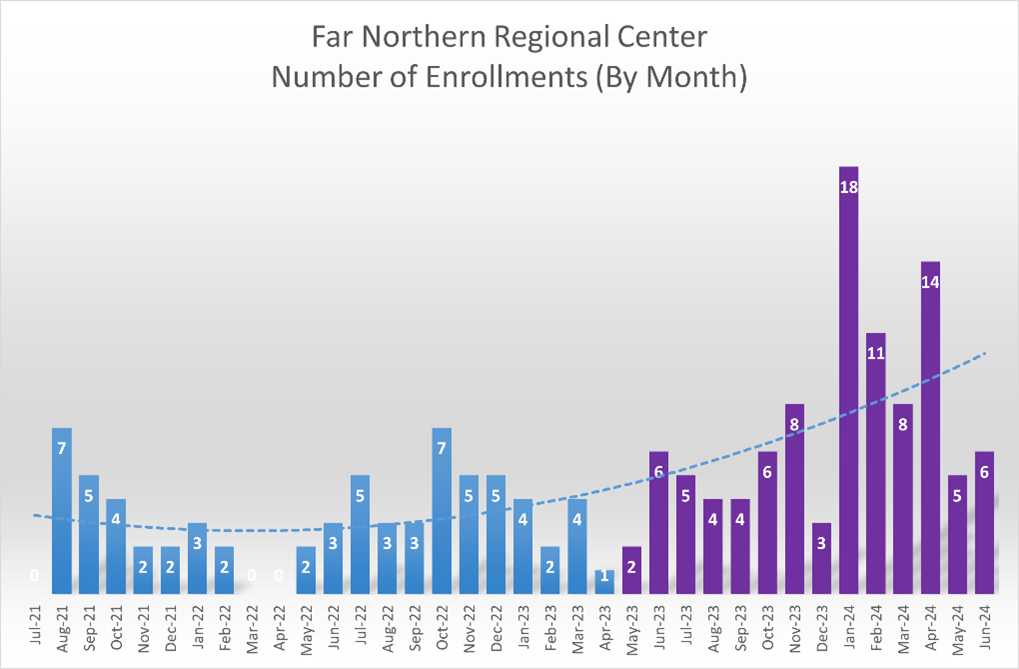
Far Northern Regional Center has created a specialized unit of Service Coordinators, including bilingual Spanish-speaking staff to serve Self-Determination Program participants. The SSDAC recognizes this as a promising practice in SDP implementation, due to the benefits that have been observed both for clients/families transitioning into SDP and to the regional center staff that serve them.
Benefits to consumers and/or families:
Those who are interested in the SDP are initially informed about the program by their current service coordinator, who is a known and trusted partner. They receive a warm hand-off to a service coordinator who is a specialist that can give them a more comprehensive understanding of the program and help them through the enrollment process.
Since this practice was implemented in May of 2023, FNRC has observed a positive trend in increased SDP enrollment, as shown in the graph below:
Benefits to the regional center:
FNRC and regional centers across the state struggle with staffing due to retirements, promotions, filling vacancies, onboarding new staff, and ongoing efforts to support and retain current staff. By empowering SC’s to simply speak to their client and families about SDP, knowing that the burden of transition and in-depth education is in the purview of specialists and that their workload will not increase, morale is maintained within the organization. With support from the LVAC and the onboarding of a project coordinator, community outreach has increased and has proven to aid in channeling information to RC consumers, families, and professionals within the field.
North Bay Regional Center has also created a Self-Determination Program unit. This unit is made up of an SDP Manager, five Participant Choice Coordinators, and a Client Service Assistant. NBRC has reportedly seen enrollment almost double between January of 2024 and May of 2025. For more information, See the North Bay Regional Center Promising Practice Presentation Slides. These slides also have information about the outreach and training projects that the regional center and Local Volunteer Advisory Committee are working on to inform their communities about the SDP.
With the hopes of seeing similar positive results, Kern Regional Center is also considering implementing this promising practice. The SSDAC will continue to monitor the results.
Oversight
The SSDAC recognizes the following as best/promising practices in oversight of the Self-Determination Program.
Disparities (Updated 9/8/2025)
It is the goal of the SSDAC, SCDD and the Department of Developmental Services to reduce disparities in access to and participation in the Self-Determination Program. The SSDAC will identify best and promising practices in reducing disparities and making self-determination accessible to all.
Targeted Outreach Events
The SSDAC recommends the use of targeted outreach events to increase access to Self-Determination Program-related information and reduce disparities in underserved communities.
Example of this best practice: Regional Center of the East Bay (RCEB) allocated funds to organizations that planned and executed targeted outreach events to the Black community and the Spanish-speaking community. The regional center released separate Request for Proposals for each in order to attract organizations that were already involved with serving the targeted communities and could tailor their approach to meet the needs of each population.
- RCEB funded a Spanish-language Self-Determination Program conference (Feria de Autodeterminación 2025), held by an organization that has a longstanding reputation for holding culturally sensitive and inclusive events that serve the region’s Spanish speaking community.
- To reach families in the Black community, RCEB provided funds to two Independent Facilitator organizations to host a table at a Black Joy Parade in February 2025, and to host a Self-Determination Program Webinar in March 2025. The webinar was attended by 130 people. Black Choice SDP East Bay established a website to house information about these events.
Outreach (UPDATED 7/8/2024)
Regional centers employ a variety of outreach methods and create outreach materials to ensure that diverse communities throughout the state are informed about the Self-Determination Program and have the resources needed to enroll. This section will include best practices in conducting outreach, as well as examples of outreach materials designed to increase equity in access to the SDP.
The brochures linked below have been identified by the SSDAC as examples of how regional centers can effectively present educational information to people interested in the Self-Determination Program
Self-Determination Program Webpage
San Diego Regional Center’s website has been identified by the SSDAC as an excellent example of how Self-Determination Program information should be organized and presented for people with I/DD and their families. This website is featured as a best practice due to the following features:
- Website content is written clearly and in plain language
- The 4 phases of enrollment in SDP are prominently displayed and described
- Testimonial videos from SDP participants are featured in multiple languages
SDRC’s website can be found at the following web address: https://www.sdrc.org/sdp
Self-Determination Program Film
Far Northern Regional Center developed a promising practice in Self-Determination Program outreach that takes a 2-pronged approach: The regional center/LVAC developed a film for outreach to educate the community about the Self-Determination Program. In 2022, they contracted with a local filmmaker Doug Churchill, (Doug Churchill Productions and Chico State Anthropology ALVA Lab) and a short documentary film was produced “The Self-Determination Program” for FNRC, featuring 3 families enrolled in the program (film project produced using SDP implementation funding). The purpose of the film is to show other families and individuals interested some of the possibilities through the program and how its improved their quality of life and services. The FNRC LVAC launched their outreach film in October 2023 through a “Premiere Event” and have continued hosting film showings through renting venues in various counties throughout its catchment area. The film events include:
-
- Introduction of “The Self-Determination Program” short documentary film
- Introduction of the FNRC LVAC members and FNRC SDP staff
- Film Showing
- Presentations from the families and individuals featured in the film
- Presentation from the film maker
- Question and Answer Session
- Following the kick-off “Premier Event” and the number of questions about the program logistics, FNRC LVAC developed a 3-hour SDP
Workshop to follow the film showings to learn more about the “nuts and bolts” of the program. These workshops topics include:
-
- Overview of the Self-Determination Program
- My SDP Journey
- Independent Facilitator (IF) Role
- How My IF Helps Me with SDP
- The Importance of Person-Centered Planning
- Vendor Perspective and SDP
- Financial Management Services and Models
- Question and Answer Session
SDP Workshop PowerPoint Presentations:
Hard Copy Resources Shared at Workshops:
Marketing/Outreach for FNRC LVAC events includes:
-
- FNRC’s website and Facebook page
- SCDD, North State Regional Office distributes the event flyers through their community email listserv
- SCDD, North State Regional Office features the events in their North State Newsletters
- FNRC’s Service Provider Advisory Committee
- FNRC LVAC members distributes through their networks
- FNRC LVAC Project Coordinator distributes event flyers to community vendors and programs
National Best Practices
States throughout the nation continue to develop programs to support the self-determination of individuals with disabilities and their families. The SSDAC will identify best and promising practices from these programs to aid in systems change and advocacy work to improve self-determination for Californians with disabilities and their families.