Proud to Be Me: Why I’m Proud to Be a Woman with a Disability
There was a time I couldn’t have written these words. A time when “cerebral palsy” felt like something to explain, to apologize for, to work around quietly so it wouldn’t take up too much space in a room. Today, I write them with my chest open and my head high: I am a woman with cerebral palsy, and I am proud of it.
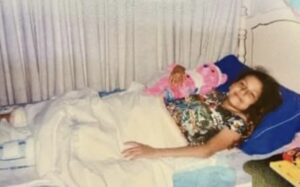
Azucena as a child.
I want to be precise about that pride, because it’s easy to misunderstand. I’m not proud in spite of my disability, as though it were a weight I’ve managed to drag uphill. I’m proud of the whole of who I am — disability included. My cerebral palsy is not the obstacle in my story. It is part of the author.
At 6 months and weighing two pounds, I was born into a set of expectations. It is a miracle I survived. My life came with a list of predictions a child like me supposedly won’t do, won’t reach, won’t become. Those predictions are offered with the best intentions and the deepest certainty, and they are meant to prepare a family for disappointment. But somewhere along the way, I stopped reading that list as a forecast and started reading it as a dare.
And so I built a life. A full one. I earned a Bachelor of Arts in Communication from the University of California, San Diego. I have traveled to 27 countries so far, and I count so far deliberately, because I’m not done. I created a bilingual podcast, Parálisis Cerebral Respuestas, holding space in both Spanish and English for a community that is too often left out of the conversation in either language. I stood at the University of Pisa, in Italy, and lectured a room full of doctors, clinicians, and researchers who had come from 18 countries across four continents, the very kind of room where, once, a list of my limitations might have been written. I co-presented at the European Academy of Childhood Disability in Heidelberg, Germany. To name only a few things. I share these not to impress, but to testify. Against all the odds. Against every line on that list. This is what life can look like.
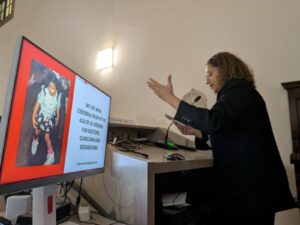
Azucena leading a lecture.
And I need to say this clearly, because so many people never hear it: my life is not a tragedy.
This is the story the world keeps trying to write for us. Disability as loss. Disability as the thing that happened to someone, the sad chapter, the cautionary tale, the inspiration only insofar as it makes able-bodied people feel grateful for what they have. I have spent my life pushing back against that story—not because it’s unkind, though it often is, but because it’s simply false. My life is not less. It is not a lesson in how to be thankful you escaped. It is rich, and difficult, and joyful, and ordinary, and extraordinary, in exactly the proportions every human life is.
What disability has given me is not limitation but perspective. It taught me early that the path everyone else assumes is the only path is just one path. It taught me to be resourceful, patient with myself, to advocate, to ask, to reinvent. It put me in community with some of the most creative, resilient, funny, and fiercely alive people I know. When I look at the disability community, I don’t see a deficit. I see ingenuity. I see people who have figured out how to move through a world that wasn’t built for them — and who do it with grace and humor and an enormous, undefeated capacity to dream.
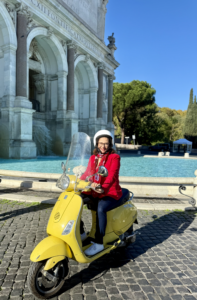
Azucena on a scooter.
That’s what Pride means to me. Not pretending the hard parts don’t exist. But refusing to let anyone else define what my life is worth. It means taking the word “disability” out of the shadows and saying it the way I’d say any other true and ordinary thing about myself. It means standing in front of the next little girl who’s just been handed her own list of impossibilities and telling her: that list is not your future. YOU get to decide what your future is.
Because here is what I have come to believe, after all of it—every doctor’s appointment, every assumption I’ve had to outlast: what truly defines us and sets us apart in this world are not our abilities or disabilities, but our attitudes, our choices, and our ability to dream—and to pursue those dreams.
I am proud of who I have become. I am proud of what I have achieved. And the truth I hold onto most tightly is this: it is only the beginning.
Continue the Journey
You just read about Azucena. Want to learn more about the supports that helped make her journey possible?
Explore the types of regional center services:
https://scdd.ca.gov/regionalcenterservices/
CONNECT WITH SCDD
BLOG ARCHIVE
SHARE YOUR STORY