Medi-Cal is More Than Health Care—It’s Independence
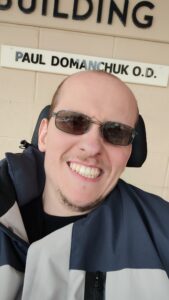
Hello, my name is Damian, and I am a 33-year-old resident of Eureka, California, living with Quadriplegic Infantile Spastic Cerebral Palsy, commonly referred to as cerebral palsy or CP. I have had this condition since birth due to being born prematurely and experiencing a brain bleed that affected the part of my brain responsible for walking, fine motor skills, and other physical abilities. Despite my disability and inability to walk, I have earned a bachelor’s degree in Spanish. I am loved, respected, and seen for who I am, not my disability. Additionally, I serve as a Peer Advocate for Reaching for Independence in Scotia, California, where I teach the people we support how to advocate for themselves, educate them on the Lanterman Act, provide documents to assist with doctor appointments called Healthcare Harmony, teach financial literacy, and address any other topics they wish to learn about, including Medi-Cal/Medicaid.
 Life has not been easy for me, but Medi-Cal/Medicaid allows me to live a life like someone without a disability. It ensures that I can have my wheelchair repaired, visit a doctor when I am ill, receive the incontinence supplies necessary for effective toileting, hire helpers to alleviate some of the burden on my family, and participate in social and recreational activities in my community with the help of transportation. These are some of the essential services that Medi-Cal/Medicaid provides for me each year. Without these services, I would not be able to function as a person. My wheelchair enables me to move around, staying healthy allows me to be happy, and having adequate incontinence supplies helps me manage bathroom issues. Additionally, I use the mental health portal funded by Medi-Cal Partnership to see a therapist once a month.
Having access to mental health services allows me to feel proud of myself, eliminate negativity, and be a beacon for those struggling to accept help or who do not know where to begin. Without these services, or if they are severely cut, I would not be able to live a happy, regular life. People with disabilities struggle to fit in, and when the world does not accommodate us, it can feel like we will never get ahead. Having someone guide us through tough times can help us become better people and realize that we matter and deserve to be happy.
If the funding cuts are implemented, it would place immense strain on the support I currently use, including the regional center and, most importantly, my family. I live with my stepfather and mother, who are at an age where it is becoming increasingly difficult for them to support me. If these cuts were to go through, it would push them to the breaking point and beyond. My parents have already sacrificed their lives to ensure that I have a modest one, and I would like to give back to them one day. They should not have to worry about me for the rest of their lives, and removing the crucial support we rely on would create a never-ending wave of worry.
In conclusion, people with disabilities are human. We are not perfect; nobody is perfect. However, we deserve to be treated fairly and equally, comparable to someone without a disability. A disability only disables us if we let it, and if you take away the supports that allow us to feel like people, then we are truly disabled in the purest form because we cannot afford the things we need. I implore you, I beg of you, please reconsider these cuts. Even if you spend just a few minutes with someone who has a disability, you will see that despite our daily challenges and barriers, we fight through them with a smile on our faces.
Thank you for your time, and I am grateful to have shared my story.
CONNECT WITH SCDD
BLOG ARCHIVE
SHARE YOUR STORY